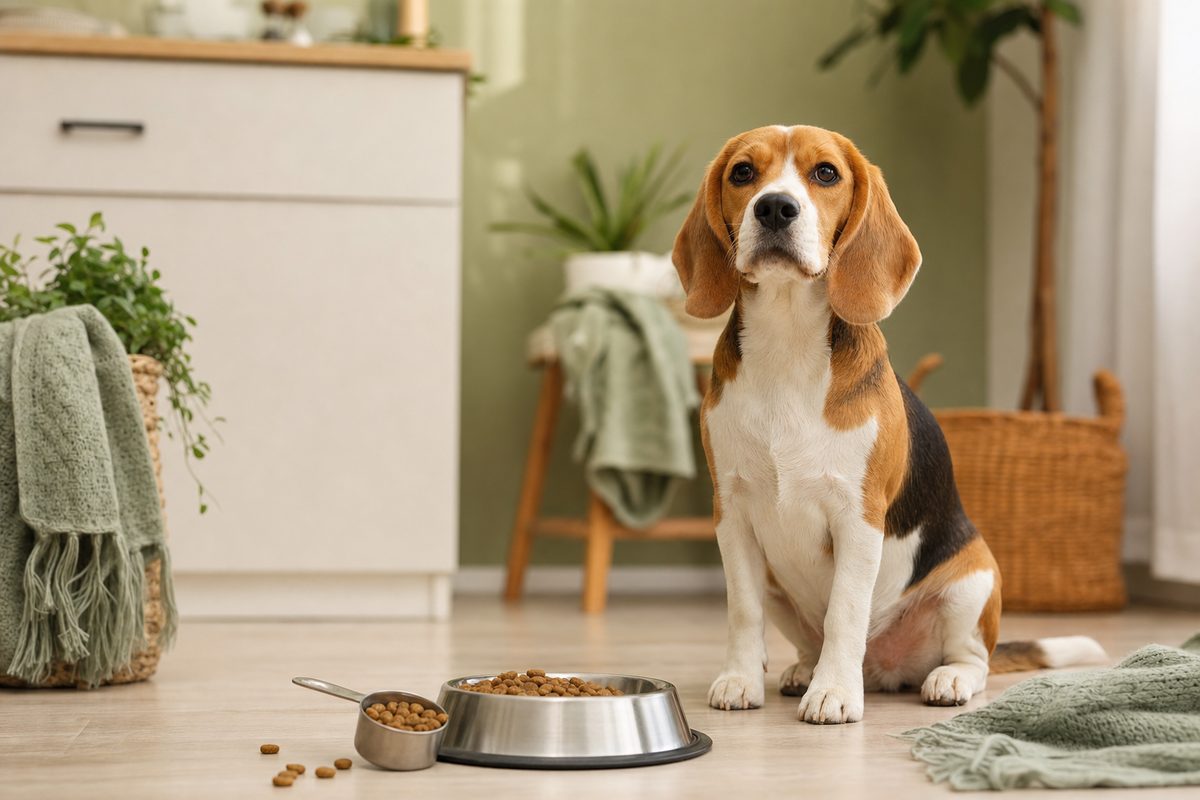
The Feeding Question Everyone Gets Wrong (Including the Bag)
Pet obesity is the #1 nutrition problem vets see, and the feeding chart on the bag is part of the reason. How to actually right-size your pet's meals.
Doctor Paws is an educational brand — nothing here replaces in-person veterinary care. Full disclosure
More than half of the dogs and cats in the US are overweight — and almost none of their owners think so. That gap matters, because extra weight quietly costs pets years: it drives arthritis, diabetes, skin disease, and shortens lifespan in well-fed, well-loved animals whose owners were just following the instructions on the bag.
Why the bag misleads you
Feeding charts on pet food are written for the range of all possible pets of a given weight — intact, active, young. Your neutered, four-year-old, apartment-dwelling dog likely needs 20 to 30 percent fewer calories than the chart's midpoint. Feed the bag's suggestion plus a few daily treats and you've engineered slow, invisible weight gain of a pound or two a year. Nobody notices until the vet does.
The check that beats every chart
You don't need a calculator — you need your hands. Feel your pet's ribs: you should find them easily under a thin layer of padding, like the back of your hand. Looking from above, there should be a visible waist. From the side, the belly should tuck up behind the ribs. If the ribs take real pressure to find, your pet is carrying extra — regardless of what the scale or the breed standard says.
Treats are where diets go to die
Typical daily extras vs. a ~500-calorie daily need — the math behind 'but we barely feed him.'
Treats should be at most 10 percent of daily calories, and most owners blow past that without realizing: a single dental chew can run 80+ calories, and a cheese cube for a 20-pound dog is roughly the human equivalent of a burger. The fix isn't fewer moments of joy — it's smaller currency. Most dogs care about the event, not the size.
Marketing words vs. meaningful words
"Premium," "holistic," "human-grade" — legally meaningless. What actually tells you a food is complete: the AAFCO nutritional adequacy statement, in small print on the back. Grain-free isn't automatically better (and has an open question mark over it in cardiology). Raw diets carry real bacterial risks the glossy ads skip. The boring truth is that several mid-priced foods are excellent and some very expensive ones are mediocre.
Getting feeding right — the right food, the right amount, body-condition checks, life-stage switches, and a sane answer to the raw/grain-free/fresh-food debates — is the single highest-leverage thing you control in your pet's health. It deserves more than the side of a bag.